
-Ajai D, Preethi P and Abinaya
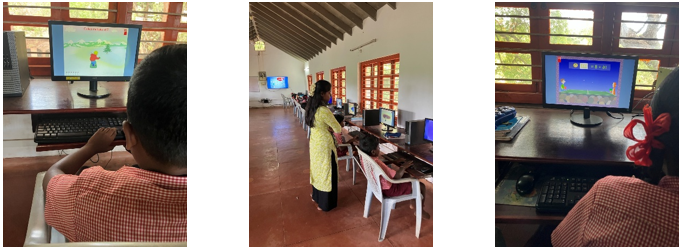
In my maths class, I tried something new. Instead of giving only worksheets for homework, I gave my students maths games on the computer and a question paper made in Snap. The children enjoyed it a lot. They paid attention, got excited, and even practised at home.
Why I used MathSoft
Many of my students were not interested in studying maths or doing sums. Doing sums on paper again and again was boring for them, so they did not practise much. Because of this, they were slow in doing sums.
I wanted to make practice fun, so that they would want to do it on their own.
Turning Sums into Games with MathSoft
I used software called MathSoft. It has many maths games. In each game, the children have to answer a maths question to keep playing. They type the answer on the computer instead of writing it in their notebook.
In one game, the children play table tennis. To hit the ball back, they have to solve a division sum like 16 ÷ 8. In another game, a boy skis down a snowy hill, and the children have to collect the multiples of a number.
The children were very involved in the games. They thought carefully about every answer because they wanted to win.
Practising at Home to Win
The best part was that the children started studying at home. They wanted to win the game in the next class, so they practised tables and problems at home without me telling them to.
Slowly, they became faster and more confident in solving problems.
A Question Paper in Snap!
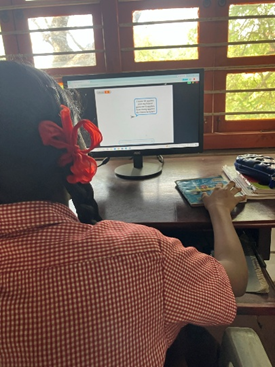
At the end, I gave them a question paper in Snap! (snap.berkeley.edu) instead of a test on paper. Here the computer asks one question at a time. The questions include word problems, BODMAS and simple algebraic equations. For example: “I have 19 apples and my friend gave me 8 apples. How many apples do I have in total?”
The children type their answer in the box. If the answer is wrong, it does not go to the next question. They have to try again until they get the correct answer. It also counts how many attempts they took.
The children were very active and interested while doing this. They tried every question and did not give up easily.
Seeing Who Needs Help
These activities also helped me to be a better teacher. While the children were doing problems on the computer, I could walk around and see how they were solving them. If a child found a problem difficult, I could help them right away.
From the number of attempts in Snap!, I could also find out which children needed more help and in which type of problems. So I knew whom to support.
Reflection
Ajai.D
This showed me that children do like maths when it is fun. When problems became a game, they practised happily, became faster, and even studied at home. It also helped me know where each child needed help. It was a very good experience. I will keep using games like MathSoft and Snap! in my maths classes.
Preethi.P
I supported Grade 6B students in a maths game. The game helped children develop curiosity and interest in learning. I noticed which children were struggling with maths and which children needed more attention. I also observed that children enjoyed learning through games and participated actively. I understood that every child learns at a different pace.
Abinaya.K
I learnt that students can learn mathematics through different approaches, such as games, worksheets, and solving problems in Snap. I understood that each student may have a different way of thinking and solving problems. I learnt the importance of giving students opportunities to explore, think independently, and try different methods instead of directly giving them answers. This helped me understand how I can support students in developing curiosity, confidence, and problem-solving skills.
Author

sandhya@auraauro.com
Related Posts

Bhishma Hunt program
The Bhishma Hunt program, organized by Sanvi Educational and Charitable Trust at Sanvi International School, invited STEM Land to lead robotics and...
Read out all
Saturday, Sanfort School Activity
-Ilakiya, Sivasankar, Ajai, NithyaSandhosh Every week, around 25 students from Sanfort International School will visit STEMLand to explore STEM activities. The school...
Read out all
Restoring Our Office Campus After the Cyclone’s Fury
-Sivaguru, SandhiyaBala, Saranya, Sanjay, Sribhavani, Arunkumar,Kugan, Rajesh, Pratap Due to the “Fengal” storm in our region, we have faced many issues, such...
Read out all
ARULVAZHI SCHOOL’S INSPIRING WEEK OF LEARNING AT STEMLAND
~ Jayabharathy, Arunkumar, Poonguzhali, Soundhariya, Gunavathi, Poovizhi From September 30, 2024 to October 4, 2024, a group of students from Arulvazhi School...
Read out allArdiuno Projects
~ Sivaraman Arduino projects are done for the learning of embedded systems programming. In simple terms, this supports make projects that are...
Read out allMindstorm Robotics during half yearly exam holidays
Lokeshwaran and Vishwa are studying in 8th grade. They have completed their half yearly exam and had holiday for a week. During...
Read out all