
-Ajai D , Abinaya and Vaishnavi
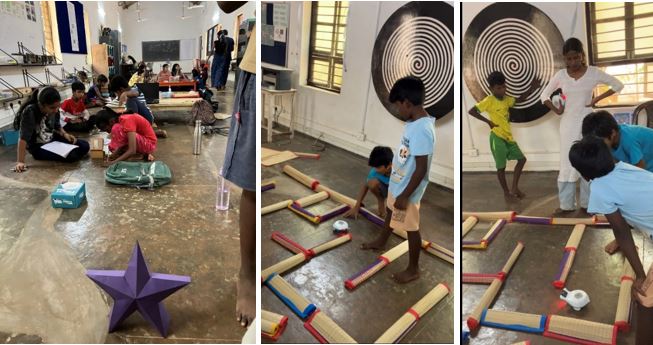
I introduced the Finch Robot to Grade 6 students during a mathematics class. The children were very excited to see the Finch Robot. They explored the different blocks in Snap and tested the robot’s movements, lights, sounds, colours, sensors, and display. Their curiosity was evident as they experimented with different commands and observed how the robot responded.
Why I Used the Finch Robot
When I started teaching addition and subtraction using a number line, I noticed that some children found it difficult to understand. I wanted to help them learn these concepts in a different, more engaging way.
There are two Grade 6 sections, Section A and Section B. I teach Section B, but I also included interested students from Section A in the Finch activity because I deeply care about equality.
So, I decided to use the Finch Robot to teach addition, subtraction, I also introduced the idea that moving the Finch Robot forward represented adding a positive number, while moving it backward represented subtracting a positive number.and the number line.
Before starting, I asked the children, “Have you seen the Finch Robot before? What do you know about it?”
Two children shared that they had seen it in STEM Land. I then introduced the robot and explained its different features, such as moving in different directions, using sensors, changing colours, playing sounds, displaying words, and drawing.
Learning Mathematics Through Movement
I connected the Finch Robot’s movement with mathematical concepts.
- Moving the Finch Robot forward represents adding a positive number.
- Moving the Finch Robot backward represents subtracting a positive number.
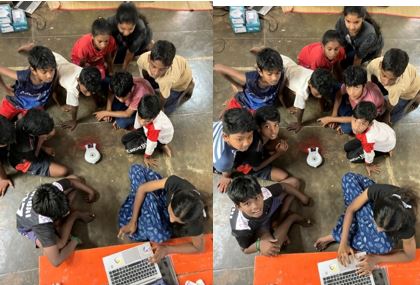
For example, if the robot started at zero and moved three steps forward, it represented:
0 + 3 = 3
If it then moved two steps backward, it represented:
3 − 2 = 1
The children could see the robot moving instead of only looking at numbers on the board. This helped them visualise how numbers change on a number line and made addition and subtraction more meaningful.
I also introduced the idea that moving the Finch Robot forward represented adding a positive number, while moving it backward represented subtracting a positive number.
Children’s Exploration and Programming
After understanding the basic movements, I encouraged the children to create their own projects using the Finch Robot.
- Some children programmed the robot to move around an obstacle without touching it. They experimented with different directions, distances, timing, and sensors until their programs worked correctly.
- Others explored creative features such as displaying words, changing colours, playing music, and using lights after the robot completed its movements.
To extend their learning, I gave the children a challenge to combine movement, sounds, and lights in one program. I designed a simple maze for the Finch Robot. The challenge was to program the robot to travel through the maze without touching the walls. If the robot successfully reached the finish, it had to play a sound and glow green to indicate that it had completed the task successfully.
The children enjoyed testing their programs repeatedly. Whenever the robot bumped into a wall or did not behave as expected, they analysed their code, changed the programming blocks, and tested again. Through this process, they learned that mistakes are part of learning and that debugging helps improve a program.
It was wonderful to see the children helping one another. Those who understood the programming blocks more quickly supported their classmates by explaining ideas and solving problems together. This created a collaborative and inclusive learning environment where everyone had the opportunity to participate.
Exploring STEM Land
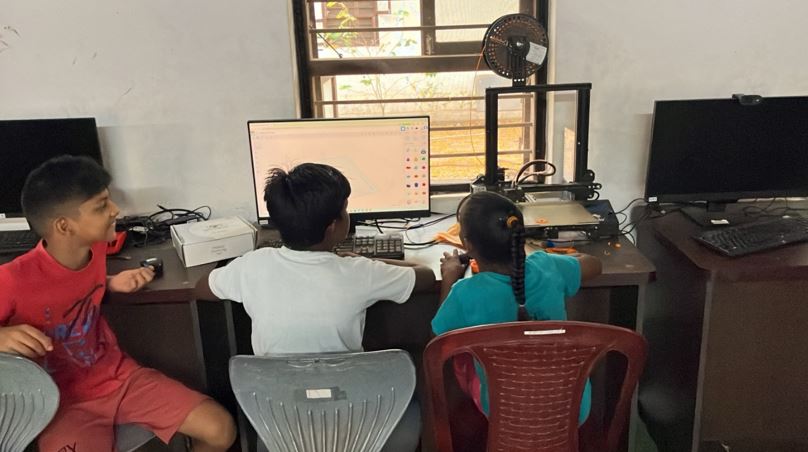
After the Finch Robot activity ended, many children continued to explore STEM Land. They spent time using other STEM materials, puzzles, educational games and 3D printing.
Their curiosity did not end with the class. Some children even visited STEM Land during the holidays because they wanted to continue exploring and learning.
Teacher reflection:
Abinaya
Through the Finch Robot activity, I observed that students became more confident and enthusiastic when they were given the opportunity to interact with the robot and test their ideas. It helped me understand that learning becomes more meaningful when students are actively involved. This experience motivated me to continue designing engaging activities that encourage curiosity, creativity, and problem-solving
Vaishnavi
Being with children is a reminder that curiosity is the beginning of learning. They ask questions without hesitation, freely express their thoughts, and eagerly explore ideas through action. Their willingness to learn by doing inspires deeper understanding and encourages creativity beyond perceived limits. Watching their enthusiasm motivates me to value curiosity, embrace exploration, and see every question as an opportunity for growth and discovery.
Ajai.D
The children’s curiosity and the way they found solutions through trial and error inspired me. Watching them explore, make mistakes, and try again helped me build my own self-confidence. It also encouraged me to face my fears, keep learning, and overcome challenges instead of giving up.
Author

sandhya@auraauro.com
Related Posts

Enhancing Health Through Yoga Practice
-Sivaguru, Saranya, Vaishnavi,Ajay I, Meenatchi, Sri Bhavani, Poonguzhali, Preethi P, Abinaya and SandhiyaBala Each Monday we have a session on self-awareness with...
Read out allCreating Experiences, Not Just English Lessons
-Sandhiya Saravanan “What did we learn today?” It is a question I ask myself after every class. But over time, another question...
Read out allLearning Together: Our Journey Through Shifu Presentations
Abinaya.k,Navanith.S,Sandhiya.S,Vaishnavi.K,Pravin.A, Gogul.B,Arshini As students from AIAT staying in the living space, we recently began attending the Shifu presentations. Before the sessions began,...
Read out all
Encouraging Active Learning Through Student Presentations on Natural Phenomena
-Vaishnavi Problem Statement While I attempted to make my science session creative and more than understanding facts and information and often did...
Read out allLearning Together, Growing Stronger
-Sandhiya Saravanan, SandhiyaBala, Ajay I, Tamilarasan, Durai, Ajay D, Kugan, Pachaiyappan, Praveenkumar, NithyaSanthosh and Sivaguru Every morning, from 7:50 to 9:00, we...
Read out allOverall Learning and Reflections from Bhutan Visit
~ Saranya During my visit to Bhutan, I got the chance to present my research paper and attend some other presentations and...
Read out all