
-Vaishnavi
“Yes, Akka… all liquids conduct electricity!”
That was the confident reply I received when I asked my students a simple question. Their certainty made me smile. After all, it did make sense to them. Electricity is dangerous, water gives shock, and elders always warn us:
“Don’t touch switches with wet hands.”
“Never stand in water during lightning.”
Many students even shared memories of their grandmothers and mothers repeating these instructions at home. In their minds, the idea was clear: Wet means liquid so liquids conduct electricity.
But science often begins exactly here with a belief that feels true.
Turning Belief into Exploration
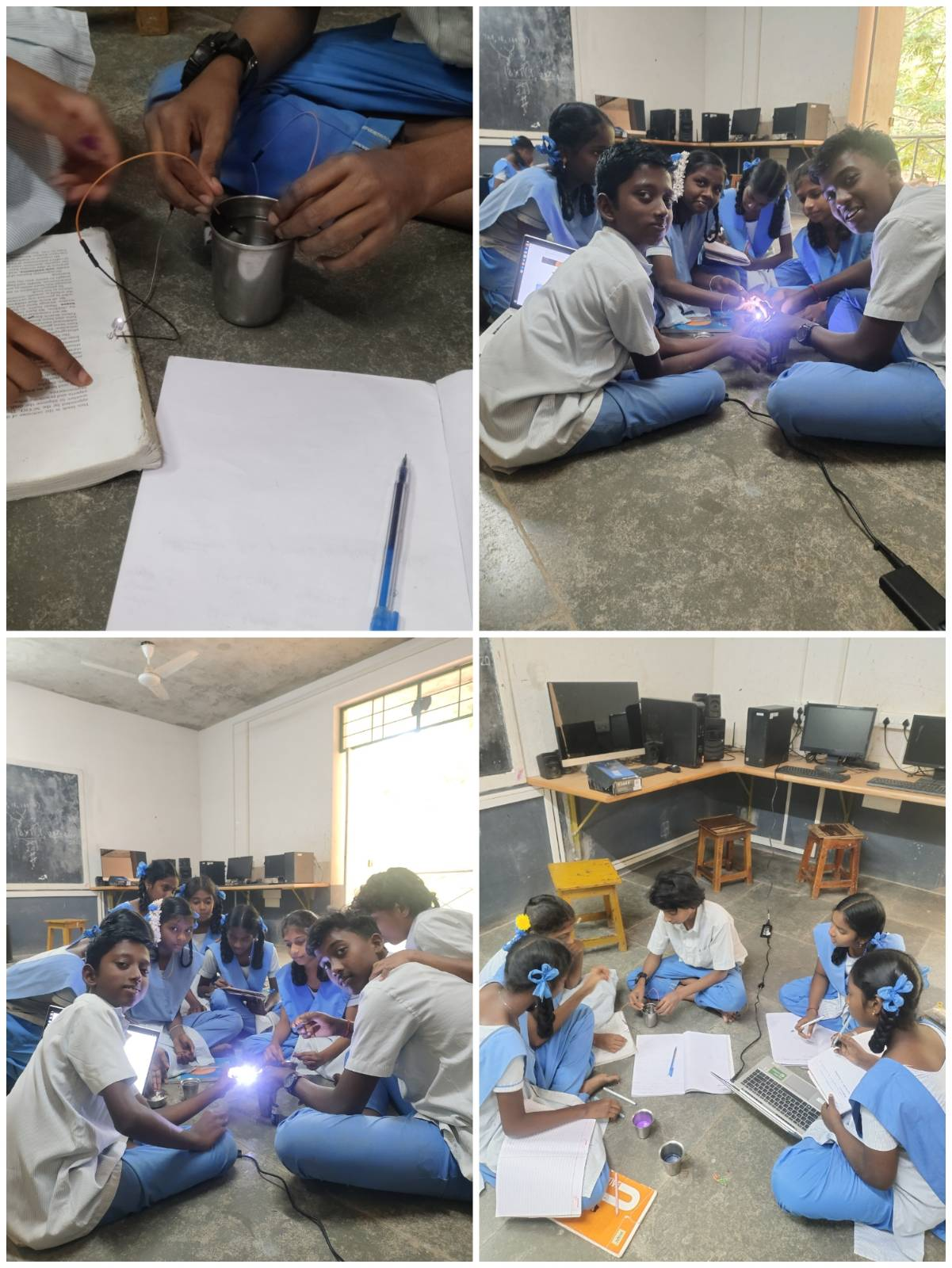
Instead of correcting them, I handed over a few materials:
- A 9V battery
- Connecting wires
- An LED
- A resistor
I asked them to make a simple circuit and then test it using different liquids.
First, we tried plain water.
The LED glowed but very dimly.
Then came salt water.
The LED shone brightly, and excitement filled the room.
Next, the students tested:
- Vim liquid
- Dishwasher liquid
- Harpic cleaner
- Groundnut oil
With each liquid, their expressions changed. Some made the LED glow well, some barely, and some not at all.
A Quiet Realisation
Slowly, without me saying much, the students began to notice a pattern.
“Akka… oil is not glowing.”
“Salt water is better than normal water.”
“Some liquids are weak conductors!”
That moment was beautiful.
They realised that not all liquids conduct electricity equally. Some are good conductors, some are poor conductors, and some do not conduct at all.
| Liquid Tested | LED Observation | Type Of Conductor |
| Salt water | Glows bright | Good conductor |
| Vim liquid | Glows bright | Good conductor |
| Harpic cleaner | Glows bright | Good conductor |
| Tap water | Glows dim | Poor conductor |
| Phenol | Very dim | Poor conductor |
| Oil (groundnut oil) | No glow | Non Conductor |
Learning Beyond the Circuit
We went back to the original belief: why are we told not to touch electrical switches with wet hands?
Now the answer came from them:
- Water usually contains dissolved salts and impurities.
- These impurities help electricity flow.
- That is why wet hands can be dangerous.
Science had gently replaced fear with understanding.
Why This Moment Matters
This activity was not just about electricity.
It was about:
- Questioning assumptions
- Learning through experimentation and observation
- Connecting daily life with science
- Discovering that “yes” or “no” is rarely the full answer
Most importantly, the students constructed knowledge themselves.
A Thought to Carry Forward
Science does not always begin with formulas or definitions.
Sometimes, it begins with a grandmother’s warning, a glowing LED, and a child’s curious eyes.
And in that moment of discovery, learning becomes truly alive.
Students Reflection:
In this activity, we learned that all liquids do not conduct electricity in the same way. We understood that water itself does not always give electric shock. Some liquids are good conductors, some are poor conductors, and some do not conduct electricity at all.
When we tested liquids using an LED, normal water gave dim light, showing it is a poor conductor. When salt was added, the LED glowed brightly, showing it became a good conductor. Phenol allowed electricity to pass, but oil did not, so the LED did not glow.
This helped us understand why we should not touch switches with wet hands. The brightness of the LED helped us identify conductors.
This activity helped us connect science with daily life and made learning fun and meaningful.
Reflection:
My name is Vaishnavi.K, I stand for Kindness and Respect. During this activity, students were highly engaged and excited. They learned by doing, thinking, and observing on their own. This showed me that when learning happens with curiosity and care, understanding becomes deeper and joyful.
Author

sandhya@auraauro.com
Related Posts
A Day of Energy, Exploration, and Learning at STEM Land
-Vaishnavi Rishi Valley School Visit on 22 January On 22nd January, STEM Land welcomed students from Rishi Valley School. The group consisted...
Read out all
5th Graders Share Their Talents at STEMland’s 10th Anniversary
-SandhiyaBala My Name is Sandhiya Bala, and I deeply care about Courage, care, and Happiness for myself and others. I was teaching...
Read out all
Exploring Awareness Through the Body (ATB) – A Teacher’s Journey
-SandhiyaBala, SivaguruPrasath and Nithya Santhosh SAIIER Teachers’ Centre recently invited teachers to a three-day workshop series called ATB for Teachers, held on...
Read out all
Plaksha School Visit
-Ilakiya, Tamil, Rajesh, Sivaguru and Aarthi STEMland was invited by Plaksha School in Andhra Pradesh for a three-day session to work with...
Read out all
Joy of Creating Puzzles in Algebraic equation
-Sribhavani New Initiative of Sanjeev for the year 2025 is to support children from 5th to 8th grade to make project and...
Read out allFruits and vegetables drawing
~Santhosh and Sandhiya Drawing is a process that all children naturally engage in, from the time they first discover they can hold...
Read out all